Resistance in electrical technology is the product of the voltage present at the two ends of
an electrical conductor and the current flowing through it (current strength).
R=U: I. This resistance is also referred to as the Ohm resistance. In addition to the
Ohm resistance, electrical technology also uses the terms “inductive resistance in
coils” and “capacitive resistance of condensers”. The unit of measure is the Ohm.
This relationship was discovered by the physicist Ohm, and the formula is
referred to as “Ohm’s law”.
U=RxI (voltage=resistance x current strength / Volt=Ohm x Ampere).
Raw iron is the first smelt produced in the blast furnace, and consists of the untreated iron obtained from iron ore. Raw iron is used as the charge material for the production of cast iron and for steel production. Hematite raw iron is used exclusively for foundry production.[1] The standard material has the following chemical analysis:
2.50 to 3.00% Si,
0.70 to 1.00% Mn,
max. 0.12% P,
max. 0.04% S,
3.70 to 4.1% C.
Foundry raw iron
Foundry raw iron is also used in foundries, and differs from hematite manly with regard to the phosphorous content, which at 0.50 to 0.70% is 4 to 6 times higher. Specular pig-iron is a special raw iron with a significantly higher manganese content of from 6 to 30%.[1] The normal analysis is:
4.00 to 5.00% C,
6.00 to 30.00% Mn,
0.10 to 0.15% P,
up to 1.00% Si,
up to 0.04% S.
Further types of raw iron
Low-carbon or high-carbon raw iron, Siegerland special raw irons, special raw iron for the production of cast iron with nodular graphite and charcoal raw iron. Raw iron is generally used in the form of pigs or ingots of approx. 20 kg in weight, or more rarely as 60 kg joined ingots consisting of 3 20 kg pigs.
References
giessereilexikon.com: Hämatitroheisen (hematite raw iron), silicon and manganese content (Si 1.5 to 4.5%, Mn up to 1.5%, very low phosphorus content); also covers Spiegeleisen (specular pig iron) with 5 to 25% manganese. Accessed 27 August 2026.
Quenching is the general term for a temperature reduction at a high cooling speed. Mould
materials with high heat conductivity lead to the quenching effect, which is all
the greater, the thinner the wall of the casting is.
Quartz is a fireproof material, which consists largely of silicon dioxide (SiO2). At 573 °C, low quartz transforms into high quartz (quartz inversion). This transformation involves a volume change and occurs rapidly in both directions. On cooling below 573 °C, the sintered layer therefore cracks; on heating, the cracks close again.
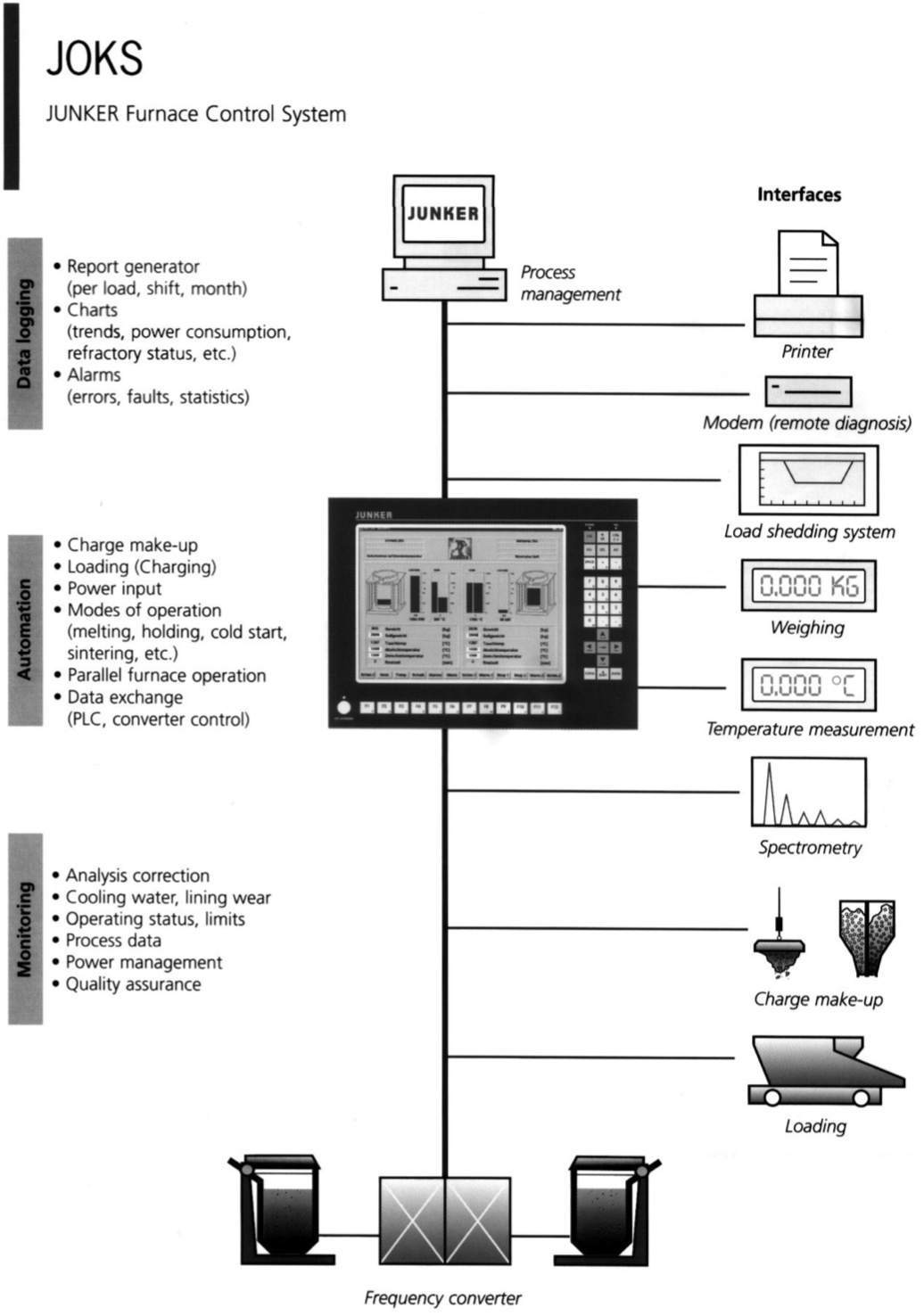
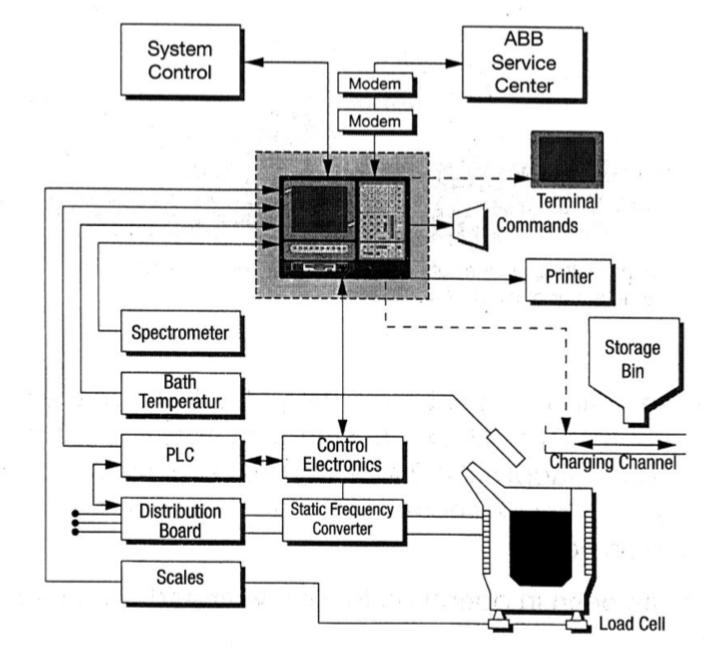
Processors are available for crucible, channel and holding furnaces and for casting units. The
melting processor fulfils the widest possible range of tasks. In the case of crucible
melting furnaces, the processor consists of a computer with colour monitor for
the information of the operating personnel, a function keyboard for the operation
of the system and a printer for recording and printing out the operating data.
The following devices are connected via the relevant interfaces:
the weighing system of the crucible furnace, which is mounted on pressure measurement units/weighing beams
the immersion temperature measurement system
the memory-programmable controls required for locking the system
the analysis spectrometer a modem for remote diagnosis or service purposes a higher-level process control system
The processor regulates and controls the furnace output and energy supply in relation to the signals it receives from the connected devices. The melt processor calculates the average temperature of the charge on the basis of the furnace contents and the amount of energy already supplied. The following information is displayed on the monitor during the running of the melting programme:
the weight of the melt
calculated average temperature of the melt
total energy consumption in relation to the charge
specific energy consumption in relation to the charge
remaining energy available
The cooling water temperatures in the individual water circuits and the supply temperature can be displayed and monitored via further connections. On completion of the melting process, an imaginary cover is placed on the system, and all the values registered so far are processed and displayed on the screen. The correction quantity of the individual materials is calculated from the temperature measurement and the analysis of the melt. Following the addition of these correction materials, they are blended in, and the melt simultaneously brought up to the preset casting temperature and target composition. The melt processor then switches the furnace to the holding mode, and instructs the operator to start the casting. After casting of the maximum quantity available, taking into account the sump quantity remaining, the next melting process can be started. Besides the control of the actual melting process, the melt processor also has several other programmes that can be called up. The processor has a programme for the starting of a cold crucible after extended shut-down, e.g. following the weekend or longer shut-down periods. The programme enables the safe inductive heating of the charged crucible, so that normal melting operations can be resumed at the start of the shift.
A further programme is available for the sintering of a newly relined crucible. After
relining, the processor controls the sintering process by means of time-related temperature profiles. The wear to the crucible is also monitored by means of the changing parameters for effective and idle output, frequency and crucible capacity
caused by the gradual reduction of the wall thickness. It calculates the washing-out
of the furnace crucible from the electrical data of the furnace. The time progression
of the wall thickness during the life of the crucible, and the current condition of the
crucible during operation are then displayed on the screen. All similar events signalled by the relevant interfaces, including any faults or problems occurring, are
registered, recorded and printed out at the appropriate time. All relevant operating
data are provided regularly via the charge report, and automatically printed out for
the last charge whenever required, or when starting the next charge. In the case of
inductively heated channel furnaces or casting furnaces, the processor stores the
following data:inductor voltage and current effective and idle output insulation
resistance between the inductor cooling jacket and the metal in the inductor channel, other parts carrying voltage and earthcooling water temperatures of the supply and individual circuits temperatures at 5 points in the boiler the processor for
this application stores all the values measured. It can display one or more of the
values on the monitor, in relation to time, and print them out on the printer as
required. The operator can select between several periods between the start of the
inductor and the last 4 hours.In order to guarantee reliability against faults, the
inputs and outputs of the computer must be connected to the furnace by memory-programmable controls. All registered and stored data can be transmitted and
processed for remote maintenance by means of a modem. With the aid of the
recorded values, the inductor diagram can be calculated and displayed. If critical
situations occur during operation, the processor generates the relevant alarm.
The integral statement regarding the relationship of effective and idle output can be assisted by the display of the losses in the water-cooled components of the housing. This also tells the operator whether the inductor is being washed out, e.g. in the area of the lower section and accumulating deposits in the upper section.
JUNKER Furnace Control System
Tele-Service
The melting processor Tele-Service module enables the ABB service team to perform diagnostics, maintenance and customer service by telephone on a world-wide basis. It connects the plants and the experts with each other throughout the world.
Tele-Service enables the service personnel in the ABB departments to operate the melting processor in the customer’s plant as if they were on site.
The fault can be diagnosed and the parameter can be changed from Dortmund via Tele-Service.
Tele-Service for the melting processor is the fastest communication of our specialists with the plants installed all over the world; it is a novel economic service from continent to continent.
Pyrometers are used for the contactless measurement of high temperatures. Depending on design, radiation pyrometers measure from about -50 °C up to 3,000 °C.[1] In iron melting, immersion thermocouples are used instead, measuring by contact rather than radiation; their range is 1,000 °C up to 1,600 °C, or briefly up to 1,800 °C.[2]
A ladle is a vessel equipped with fireproof cladding used for holding the melt from a
furnace for the purposes of transport or casting. These come in the different
forms of transport and casting ladles.